
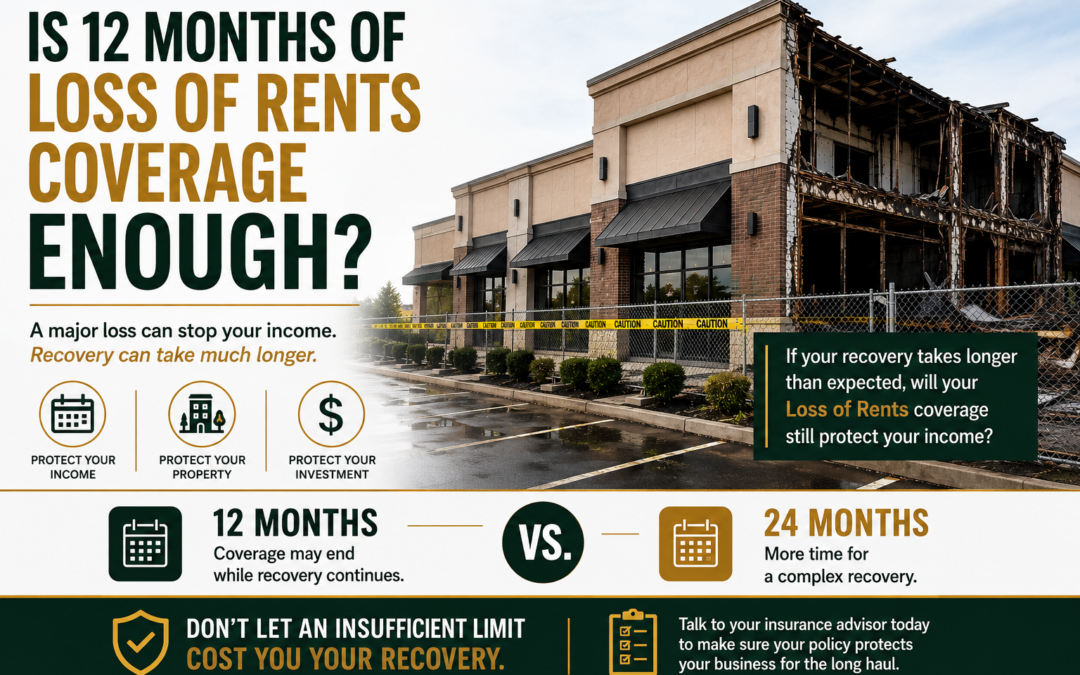
Is 12 Months of Loss of Rents Coverage Enough for a Commercial Property?
A major fire or other covered property loss can stop rental income almost immediately. Rebuilding the property, however, can take far longer than many commercial property owners expect.
That creates an important question:
If your commercial property takes 18 months, 20 months, or even longer to restore, what happens if your Loss of Rents coverage ends after 12 months?
For owners of apartment complexes, office buildings, shopping centers, strip centers, mixed-use properties, and other income-producing real estate, insuring the physical building is only part of protecting the investment.
The property’s income stream deserves just as much attention.
Understanding the relationship between Business Income, Loss of Rents, the period of restoration, and the time it could realistically take to rebuild is an important part of creating a strong commercial property insurance program.
What Is Loss of Rents Coverage?
Loss of Rents coverage helps protect rental income when covered physical damage prevents an income-producing property from being occupied or generating its normal rental income, subject to the terms, conditions, limits, and exclusions of the policy.
Depending on the policy, this protection may be included within Business Income coverage or structured specifically around rental value.
For a commercial property owner, this can be critical because a major loss can interrupt revenue while many financial obligations continue.
Those continuing expenses may include:
- Insurance expenses
- Loan or mortgage obligations
- Management expenses
- Property taxes
- Utilities and other continuing expenses
The rent can stop. The bills usually don’t.
That’s why commercial property owners should evaluate both how much income is being insured and how long that protection may need to last.
Why 12 Months of Loss of Rents Coverage May Not Be Enough
Twelve months can sound like a long time to repair or rebuild a commercial property.
After a significant loss, it may not be.
A major commercial property claim can involve considerably more than hiring a contractor and beginning construction. Before tenants can return and normal rental income resumes, the owner may have to work through multiple stages of recovery.
The recovery process may include:
- Architectural and engineering work
- Claim investigation and adjustment
- Code-required upgrades
- Contractor scheduling
- Inspections
- Material and equipment procurement
- Permitting
- Reconstruction
- Tenant re-occupancy
A delay during any one of these stages can affect the overall recovery timeline.
For example, construction may not begin immediately after a fire. The cause and extent of the damage may first need to be evaluated. Plans may need to be prepared. Permits may require approval. Contractors and materials must be available.
If the building is older, current building codes may further affect the scope, expense, and timeline of reconstruction.
The period between the date of loss and the date tenants can actually return may be substantially longer than the construction period itself.
12 Months vs. 18 Months vs. 24 Months of Loss of Rents Coverage
There isn’t one coverage period that’s appropriate for every commercial property.
A smaller, relatively simple building may have a very different potential recovery timeline than a large apartment complex, multi-tenant office building, older shopping center, or industrial property.
The coverage period should reflect the characteristics and potential recovery timeline of the actual property.
12 Months
A 12-month period may provide sufficient protection for some properties and losses. However, property owners should understand what would happen if permitting, code compliance, reconstruction, inspections, or re-occupancy extends beyond that period.
18 Months
An 18-month period may provide additional time for a more complicated recovery and can be worth evaluating when the property’s age, construction, occupancy, location, or other characteristics could extend the rebuilding process.
24 Months
For properties where a major loss could involve lengthy permitting, code upgrades, complex reconstruction, or multiple tenants, 24 months of Business Income or Loss of Rents protection may provide a more appropriate recovery window.
The objective isn’t automatically to purchase the longest period available.
The objective is to make sure your coverage realistically reflects how long your particular property could take to recover from a major covered loss.
What Could Delay Rebuilding a Commercial Property?
The physical construction itself is only one part of a commercial property recovery. Several factors can potentially extend the time between the initial loss and the return of normal rental income.
Architectural & Engineering Work
Significant structural damage may require architects, engineers, consultants, or other professionals before reconstruction plans can be completed and submitted for approval.
Claims Adjustment
The insurer must investigate the claim, evaluate the extent of covered damage, and work through the adjustment process. Complex commercial property losses can require significant evaluation before reconstruction moves forward.
Code Upgrades
An older property may have been constructed under building codes that differ substantially from today’s requirements.
Following a covered loss, enforcement of current codes may require additional work involving accessibility, electrical systems, fire and life safety, plumbing, structural requirements, and other improvements.
This is one reason Ordinance or Law coverage for commercial properties deserves careful attention, particularly for older apartment complexes, office buildings, retail centers, and other older structures.
Contractor Availability
A major reconstruction may require general contractors and numerous specialized subcontractors. Their availability can affect both when reconstruction begins and how quickly it progresses.
Inspections
Different stages of reconstruction may require inspections and approvals before additional work can continue or the building can legally be occupied again.
Material & Equipment Availability
Specialized building materials, electrical equipment, elevators, HVAC components, mechanical systems, and other equipment can affect reconstruction schedules.
Permitting
Reconstruction plans may require governmental review and approval before work can begin. The complexity of the property, local requirements, and scope of the reconstruction can all affect that timeline.
Tenant Re-Occupancy
Completing physical reconstruction does not necessarily mean rental income immediately returns to its pre-loss level.
Tenants may need time to rebuild their own spaces, install equipment, obtain approvals, move back into the property, or resume normal operations.
Loss of Rents Coverage for Apartment Complexes
For an apartment complex or multi-family property, rental income is fundamental to the economics of the investment.
A significant fire could make multiple units—or potentially a substantial portion of the property—temporarily uninhabitable.
Meanwhile, the owner may continue to face expenses associated with the property.
Older apartment complexes can create an additional concern: Ordinance or Law requirements.
If reconstruction requires portions of an older property to meet current building codes, the recovery can become more complicated and may take longer than originally anticipated.
Apartment owners should evaluate the relationship between:
- Building replacement cost
- Business Income and Loss of Rents
- Extended periods of restoration
- Ordinance or Law coverage
- Property deductibles
- Rental income projections
These coverages shouldn’t be considered independently. They work together to determine how effectively the property and its income may be protected following a major covered loss.
Loss of Rents Coverage for Office Buildings
A multi-tenant office building can create a different recovery challenge.
Damage may affect individual tenant spaces, common areas, building systems, elevators, electrical service, HVAC systems, or access to the property.
Even tenants whose individual suites sustained limited physical damage may be unable to operate if essential building systems are unavailable.
For older office properties, code requirements and commercial property coverage should be evaluated together with the potential length of the income interruption.
The important question isn’t simply how long repairs could take. It’s how long it could take before tenants can safely and legally occupy the building and normal rental income resumes.
Loss of Rents Coverage for Shopping Centers & Strip Centers
Retail properties can be particularly sensitive to business interruption.
One significant fire or other covered loss may affect multiple tenants, common areas, customer access, utilities, or an entire section of a shopping center.
A landlord could therefore experience an interruption in rental income from more than the tenant or area where the original physical damage occurred.
For older shopping centers and strip centers, the potential combination of property damage, Ordinance or Law requirements, reconstruction delays, and interrupted rental income makes the length and amount of Business Income or Loss of Rents coverage especially important to review.
How Much Loss of Rents Coverage Should a Commercial Property Owner Have?
The answer should be based on the economics and characteristics of the property rather than an arbitrary number.
Owners should evaluate the income the property is expected to generate and determine how a significant covered loss could affect that income.
Important considerations include:
- Current rental income
- Lease structures
- Number of tenants
- Occupancy levels
- Operating expenses
- Potential reconstruction period
- Projected rental income
- Property type
- Vacancy exposure
The policy’s specific definition of rental value, applicable limits, waiting periods, period of restoration, exclusions, and other provisions also matter.
Simply seeing “Business Income” or “Loss of Rents” listed on a policy does not tell you whether the amount or duration of coverage is adequate for your property.
What Is the Period of Restoration?
The period of restoration is an important concept in Business Income and Loss of Rents insurance.
Generally, it defines the period during which covered income loss may be measured following covered physical damage, subject to the specific wording of the policy.
Commercial property owners should understand when their policy’s applicable period begins, when it ends, and whether additional or extended coverage applies after physical repairs are completed.
This is an area where the actual policy language matters significantly.
Do not assume that choosing a particular dollar limit automatically means rental income will be protected for as long as it takes your property to recover.
What Happens If Loss of Rents Coverage Ends Before Reconstruction Is Complete?
This is the scenario commercial property owners should consider before a loss occurs.
Suppose a major covered fire results in an extended recovery.
The owner receives covered Loss of Rents payments during the applicable coverage period. However, permitting, reconstruction, inspections, or tenant re-occupancy takes longer than anticipated.
If the applicable Business Income or Loss of Rents protection ends while the property is still unable to generate normal rental income, the remaining income shortfall may become the owner’s financial responsibility.
That can be particularly difficult when loan payments, property taxes, insurance, and other continuing financial obligations remain.
Business Income Coverage and Ordinance or Law Coverage Work Together
One of the most important lessons for owners of older commercial properties is that individual property coverages shouldn’t be evaluated in isolation.
Consider an older apartment complex after a major covered fire.
Building coverage may be needed to repair covered physical damage.
Business Income or Loss of Rents coverage may help protect the income stream during a covered interruption.
Ordinance or Law coverage may help address certain additional expenses resulting from enforcement of current building codes after a covered loss.
And the limits and coverage periods need to reflect the potential scope and duration of the recovery.
A weakness in one area can affect the effectiveness of the entire commercial property insurance program.
Learn more about how these coverages work together in our comprehensive guide to Commercial Property & Investment Property Insurance.
Questions to Ask About Your Loss of Rents Coverage
Commercial property owners should be able to answer these questions before a major claim occurs:
- Are my current rental figures accurately reflected in my coverage?
- Does my coverage account for projected rental income?
- How does my policy define the period of restoration?
- How long could permitting and reconstruction realistically take?
- How much Business Income or Loss of Rents coverage do I have?
- What happens if tenants cannot immediately return after reconstruction?
- What limits, waiting periods, or exclusions apply?
- Would 18 or 24 months be more appropriate for my property?
If you’re unsure of the answers, that’s a good reason to review the policy before you need to use it.
Don’t Wait Until Month 13 to Discover You Needed More Time
A major commercial property loss can involve claims adjustment, code compliance, design, inspections, permitting, reconstruction, and tenant re-occupancy before the property’s income returns to normal.
For some properties, that can make 12 months an uncomfortably short recovery window.
The worst time to discover that your Loss of Rents protection is too short is while your building is still under reconstruction.
At McClatchy Insurance Agency, we help commercial property owners evaluate more than the replacement cost of the building. We look at the property, its income, potential recovery timeline, and the coverages that work together to help protect the investment.
McClatchy has been advising Sacramento-area businesses, real estate owners, and investors since 1927. You can also explore our broader commercial insurance solutions for additional ways to protect your business and assets.
If you own an apartment complex, office building, shopping center, strip center, mixed-use building, warehouse, or other income-producing commercial property, review your commercial property insurance coverage before a loss determines whether your protection was adequate.
How Long Could Your Property Afford to Be Without Rental Income?
Contact McClatchy Insurance Agency to review your Business Income and Loss of Rents coverage and determine whether your current insurance strategy reflects the time your property could realistically need to recover.
Request a Commercial Property Insurance Review
Call (916) 488-4702
Insurance coverage is subject to the specific terms, conditions, limits, deductibles, exclusions, and endorsements of the applicable policy. Coverage needs vary by property and policy. This information is for general educational purposes and is not a substitute for reviewing your individual insurance policy with a qualified insurance professional.
