
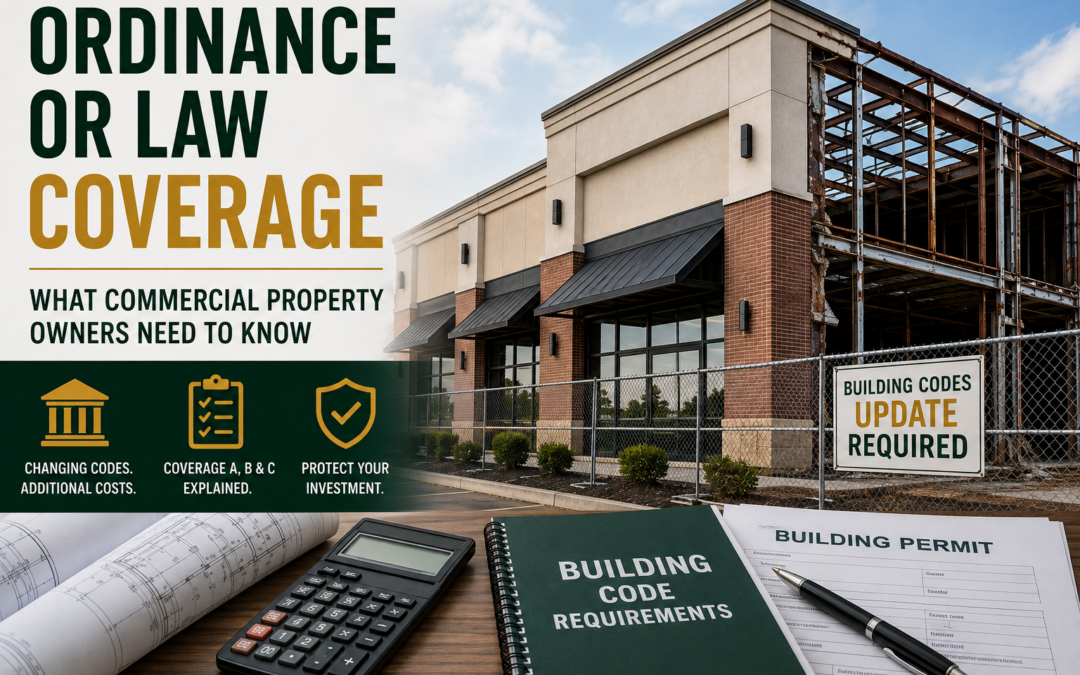
Ordinance or Law Coverage: What Commercial Property Owners Need to Know
A major property loss can create expenses that go far beyond repairing the portion of a building that was damaged.
If your insurance pays to rebuild your commercial property, who pays the additional cost of bringing an older building up to today’s building codes?
That question can become extremely important after a fire, structural loss, or other covered event involving an older apartment complex, office building, shopping center, mixed-use property, or other commercial real estate.
Building codes change. Older buildings often do not.
When a damaged property must be repaired or reconstructed under current codes, the owner may face additional costs involving demolition, accessibility, electrical systems, fire and life safety, plumbing, structural requirements, and other mandated improvements.
Ordinance or Law coverage is designed to address certain losses and additional costs caused by the enforcement of building laws or ordinances following a covered property loss, subject to the terms and limits of the policy.
It can be an important part of a well-structured commercial property insurance program—particularly for owners of older buildings.
What Is Ordinance or Law Coverage?
Ordinance or Law coverage helps address certain additional costs that may arise when a damaged commercial building must comply with current building codes during repair or reconstruction.
Commercial property insurance is generally designed to respond to covered physical damage. However, the cost of complying with current laws and ordinances can create additional expenses that go beyond repairing the damaged portion of the building.
Depending on the policy and endorsements selected, Ordinance or Law protection may address three important areas:
- Loss of the undamaged portion of the building that must be demolished
- Demolition costs associated with that undamaged portion
- Increased construction costs required to comply with current codes
The key issue is not simply what was physically damaged. It is what the law may require you to do because the damage occurred.
Why Ordinance or Law Coverage Matters for Older Commercial Buildings
An older building may have been perfectly legal when it was originally constructed.
Over time, however, building standards can change substantially.
A commercial property constructed decades ago may not meet current requirements involving:
- Accessibility
- Electrical systems
- Energy standards
- Fire and life safety systems
- HVAC systems
- Plumbing
- Seismic or structural requirements
- Sprinkler systems
Those differences may not create a problem during ordinary operation.
They can become very important after a major loss.
If a fire damages part of an older property, the local building authority may require reconstruction to meet current standards. Depending on the circumstances, those requirements can add significant expense and potentially extend the recovery period.
A building can be insured for replacement cost and still face additional code-related expenses after a major loss.
Ordinance or Law Coverage A, B & C Explained
Ordinance or Law coverage is commonly discussed in three parts: Coverage A, Coverage B, and Coverage C.
Understanding the difference can help property owners see why code-related losses can involve more than simply rebuilding damaged property.
Coverage A – Loss of the Undamaged Portion of the Building
Imagine that a fire significantly damages one section of a commercial building.
The remaining portion of the building may still be physically intact. However, a building ordinance or law could require the entire structure—or an additional undamaged portion—to be demolished.
Coverage A may help address the value of the undamaged portion that must be demolished because of enforcement of an ordinance or law.
This distinction can be extremely important because the undamaged portion may not otherwise be considered direct physical damage from the original covered event.
Coverage B – Demolition Costs
If an ordinance requires an undamaged portion of the building to be demolished, there is another expense to consider:
Who pays to tear it down?
Demolition itself can involve contractors, equipment, debris removal, engineering, environmental considerations, permits, and other expenses.
Coverage B may help pay the cost of demolishing the undamaged portion of the building when demolition is required by an applicable ordinance or law.
Coverage C – Increased Cost of Construction
Coverage C addresses another major concern for owners of older commercial buildings:
The additional cost of rebuilding to current codes.
After a covered loss, the replacement structure may need upgraded systems or construction methods that were not part of the original building.
Depending on the property and applicable requirements, those upgrades could involve:
- Accessibility improvements
- Electrical upgrades
- Energy-efficiency requirements
- Fire protection systems
- Plumbing upgrades
- Structural improvements
- Other code-mandated construction
Coverage C may help address certain increased construction costs caused by enforcement of current building laws or ordinances.
Coverage always depends on the policy’s specific wording, limits, exclusions, and endorsements.
A Simple Example: An Older Apartment Complex After a Fire
Consider an older apartment complex that suffers a significant covered fire.
Part of one building is severely damaged, while another portion remains standing.
During the reconstruction process, local authorities determine that current codes require additional work involving electrical systems, accessibility, fire protection, and other building components.
The owner could potentially face several different categories of expense:
- Repairing the physically damaged portion of the building
- Demolishing an undamaged portion if required by code
- Replacing the value of that undamaged portion
- Rebuilding portions of the property to current standards
- Managing a longer reconstruction timeline
- Continuing to lose rental income during the recovery
This is why commercial property owners should look beyond the building limit alone. A major loss can create multiple financial exposures at the same time.
Ordinance or Law Coverage for Apartment Complexes
Apartment complexes and other multi-family properties deserve particular attention because many properties were built years—or even decades—before today’s codes.
Older apartment properties may have legacy electrical systems, plumbing, fire protection systems, accessibility configurations, or structural features that differ from current requirements.
A major covered loss could therefore trigger code-related reconstruction requirements that materially change the scope of the project.
Owners of apartment complexes should evaluate Ordinance or Law coverage together with:
- Building replacement cost
- Business Income and Loss of Rents coverage
- Common-area liability
- Extended restoration periods
- Property deductibles
- Rental income projections
For an income-producing property, rebuilding the structure and protecting the rental income stream should be considered together.
Learn more about income protection in our guide, Is 12 Months of Loss of Rents Coverage Enough?
Ordinance or Law Coverage for Condo Associations & HOAs
Condo associations and homeowners associations can face particularly complicated property insurance issues because responsibility may be divided between the association’s master policy and individual unit owners.
After a major loss, code requirements may affect common property such as:
- Common hallways
- Electrical systems
- Elevators
- Exterior structures
- Fire protection systems
- Roofs
- Shared mechanical systems
Association boards should understand what the master policy insures, what individual owners are responsible for, and how Ordinance or Law requirements would be addressed after a major covered loss.
Those questions are much easier to resolve before a claim occurs.
Ordinance or Law Coverage for Office Buildings
Older office buildings can present a wide range of code-related exposures.
A major reconstruction may affect elevators, electrical systems, HVAC equipment, common areas, accessibility, fire protection systems, tenant spaces, and other building components.
Even when physical reconstruction is technically possible, the building may not be ready for tenants to return until all required inspections and approvals have been completed.
This creates an important connection between Ordinance or Law coverage and Business Income and Loss of Rents coverage.
Code compliance can affect both the cost of reconstruction and the time required to complete it.
Ordinance or Law Coverage for Shopping Centers & Strip Centers
Shopping centers and strip centers often include multiple tenants, shared utilities, common areas, specialized electrical systems, fire protection equipment, and older building components.
A significant covered loss can therefore affect more than the individual suite where the damage began.
Depending on the building and applicable laws, reconstruction could require upgrades affecting larger portions of the center.
This can create a combination of:
- Code-related reconstruction expenses
- Extended project timelines
- Interrupted rental income
- Multiple affected tenants
- Potential common-area issues
For multi-tenant retail properties, the financial impact of a major loss may extend well beyond the damaged walls and roof.
Replacement Cost Does Not Automatically Mean Every Code Upgrade Is Covered
This is one of the most important distinctions for commercial property owners to understand.
Replacement Cost coverage generally addresses the cost to repair or replace covered property with materials of like kind and quality, subject to the policy.
But rebuilding under today’s laws and ordinances can involve additional requirements that were not part of the original building.
Replacement Cost and Ordinance or Law coverage address related—but different—issues.
A commercial property can therefore have a substantial replacement cost limit while still needing additional Ordinance or Law protection.
For a broader explanation of building valuation and property protection, visit our Commercial Property Insurance guide.
How Building Codes Can Extend the Recovery Timeline
Code compliance doesn’t only affect reconstruction costs.
It can also affect how long a property remains out of service.
A major claim may involve additional:
- Architectural work
- Engineering
- Inspections
- Permit review
- Planning
- Reconstruction
- Specialized contractors
Those requirements can potentially extend the time between the initial loss and the point when tenants can return.
That is why Ordinance or Law coverage should be reviewed alongside Business Income and Loss of Rents protection.
If code-required upgrades add months to the project, the owner should understand whether the income protection is structured to reflect that potential timeline.
Read more: Why 12 Months of Loss of Rents Coverage May Not Be Enough.
How Much Ordinance or Law Coverage Does a Commercial Property Need?
There is no single limit that is appropriate for every property.
The amount of protection should reflect the characteristics of the actual building and the potential consequences of rebuilding under current requirements.
Factors to evaluate include:
- Age of the building
- Building construction
- Current code requirements
- Location
- Occupancy
- Property size
- Replacement cost
- Type of property
A newer building constructed under relatively current codes may have a different exposure than a property built several decades ago.
The older and more complex the building, the more important it may be to understand the potential cost of code compliance after a major loss.
Questions Commercial Property Owners Should Ask
Property owners should review Ordinance or Law coverage before a claim forces the issue.
Questions worth asking include:
- Does my property policy include Ordinance or Law coverage?
- How are Coverages A, B, and C structured?
- How old is my building compared with current codes?
- What code upgrades could be required after a major loss?
- What limits apply to demolition expenses?
- What limits apply to increased construction costs?
- Would code compliance extend my reconstruction timeline?
- Would my Loss of Rents coverage last through that extended recovery?
If you’re not sure how your policy would answer those questions, that’s a good reason to review it now.
The Hidden Cost of Rebuilding an Older Commercial Property
When owners think about a major property loss, the first concern is usually the obvious physical damage:
How much will it cost to rebuild?
But the true financial impact can be broader.
A major loss may potentially involve:
- Building damage
- Code-required improvements
- Demolition expenses
- Extended reconstruction
- Lost rental income
- Tenant delays
The real question is not only, “Is my building insured?” It is, “How would my entire insurance program respond if rebuilding becomes more complicated than expected?”
Ordinance or Law Coverage Should Be Part of the Bigger Commercial Property Conversation
No single endorsement protects every aspect of a commercial property loss.
A strong commercial property insurance program may involve several coverages working together.
Depending on the property and policy, those may include:
- Building coverage
- Business Income
- Equipment Breakdown
- Extra Expense
- Loss of Rents
- Ordinance or Law
- Replacement Cost
- Tenant Improvements & Betterments
- Water Backup
Each coverage addresses a different piece of the risk.
That’s why owners should evaluate the property as an investment—not simply as a building.
Explore the complete Commercial Property Insurance resource from McClatchy Insurance Agency for a broader explanation of the coverages commercial property owners should consider.
Don’t Discover a Building Code Gap After the Loss
A major covered property loss is already disruptive.
Finding out during reconstruction that current building codes require substantially more work can make the situation even more difficult.
The time to understand Ordinance or Law coverage is before the building inspector tells you what must change.
At McClatchy Insurance Agency, we help commercial property owners evaluate the risks surrounding their buildings, rental income, reconstruction exposures, and long-term investment.
For commercial property owners in Sacramento and throughout Northern California, that review can include evaluating replacement cost, Ordinance or Law coverage, Business Income, Loss of Rents, and the potential time required to recover from a major loss.
You can also explore McClatchy’s broader commercial insurance solutions for additional ways to protect your business and investment.
Would Your Commercial Property Insurance Cover the Cost of Rebuilding to Today’s Codes?
If you own an apartment complex, office building, shopping center, strip center, mixed-use building, warehouse, or other commercial property, now is the time to find out.
Contact McClatchy Insurance Agency to review your commercial property coverage and determine whether your Ordinance or Law protection reflects the building you actually own.
Request a Commercial Property Insurance Review
|
Call (916) 488-4702
Insurance coverage is subject to the specific terms, conditions, limits, deductibles, exclusions, and endorsements of the applicable policy. Ordinance or Law requirements and coverage needs vary by property, jurisdiction, and policy. This information is for general educational purposes and is not a substitute for reviewing your individual insurance policy with a qualified insurance professional.
